
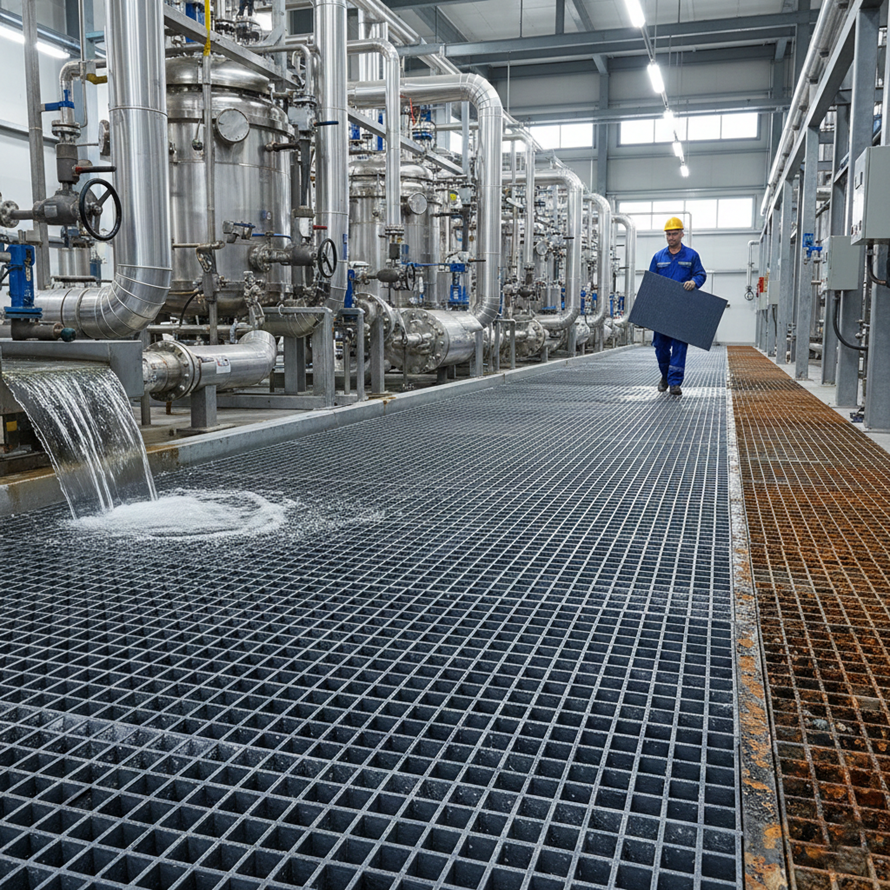
Rethinking Industrial Flooring: GRP Gratings from Al-Najof Fiberglass
Industrial flooring is rarely glamorous. It is expected to endure weight, moisture, chemicals, and constant use without complaint. For decades, steel and aluminum carried that burden almost by default. Lately, though, that assumption has begun to shift. In facilities where corrosion, electrical risk, or maintenance costs quietly accumulate over time, composite materials—particularly GRP gratings produced by Al-Najof Fiberglass—are increasingly part of the conversation.
So what exactly is GRP?
Glass Reinforced Plastic is a composite material formed by embedding glass fibers within a thermosetting resin. The glass provides tensile strength; the resin binds and protects. The outcome is not simply a lighter substitute for metal, but a structurally distinct material with different mechanical and chemical behaviors. In aggressive environments—salt-laden air, chemical exposure, continuous moisture—this distinction matters. Steel oxidizes. Aluminum pits. GRP, by contrast, appears to resist these processes rather than merely slowing them.
Al-Najof Fiberglass has positioned its GRP gratings within this context. The panels are manufactured to withstand conditions where corrosion is not an occasional inconvenience but a daily reality. Chemical processing plants, wastewater treatment facilities, and marine structures tend to illustrate the point clearly: maintenance cycles shorten rapidly when metal flooring begins to deteriorate. In such settings, the long-term performance of composite grating may offer practical advantages, though site-specific load requirements always warrant careful evaluation.
Weight is another factor that often escapes attention until installation begins. Steel grating demands lifting equipment, coordinated labor, and time. GRP panels are considerably lighter. That difference does not eliminate structural responsibility—load calculations remain essential—but it can simplify transport and placement. In projects where downtime carries financial consequences, faster installation may translate into measurable savings.
Safety considerations introduce yet another dimension. Slips and electrical hazards are persistent risks in industrial environments. GRP’s molded surface texture is typically designed to improve traction, particularly in wet or oily areas. Equally significant is its non-conductive nature. Unlike metal flooring, it does not transmit electricity, which may reduce certain types of risk in substations or processing zones. That said, no material replaces proper grounding protocols or broader safety planning; it functions as one element within a larger system.
Maintenance is where the material’s differences become most visible over time. GRP does not rust, and because its color is integrated throughout the panel rather than applied as a coating, repainting is unnecessary. Metal grating, especially outdoors or near chemicals, often requires periodic surface treatment to prevent degradation. The cumulative cost of these cycles—labor, shutdowns, coatings—can exceed initial procurement differences. Whether that lifecycle advantage holds depends on exposure conditions and inspection schedules, but the comparison is difficult to ignore.
Applications reflect these characteristics. Industrial walkways, elevated platforms, and trench covers are common uses. Offshore and marine decks benefit from corrosion resistance in salt-heavy air. Water and wastewater facilities rely on materials that tolerate continuous humidity. Oil and gas installations may favor non-conductive surfaces in specific operational zones. Even architectural projects sometimes adopt GRP where low maintenance and durability outweigh aesthetic preferences for metal.
When set beside steel or aluminum, the contrasts are straightforward. GRP tends to resist corrosion more effectively. It weighs less. It generally requires less surface upkeep. It maintains traction under wet conditions. And it does not conduct electricity. Metals, by comparison, can be heavier, prone to corrosion without treatment, and conductive by nature. Each material carries trade-offs, of course—structural demands, temperature tolerance, and regulatory requirements must all be assessed before selection.
Ultimately, the case for GRP gratings from Al-Najof Fiberglass rests less on novelty and more on context. In environments defined by moisture, chemicals, or electrical exposure, composites may offer a practical alternative to traditional metals. Not universally superior. Not automatically appropriate. But in many industrial settings, they appear to address long-standing weaknesses in conventional flooring systems.
| Feature | GRP Grating | Steel/Aluminum |
|---|---|---|
| Corrosion resistance | Excellent | Poor |
| Weight | Lightweight | Heavy |
| Maintenance | Low | High |
| Slip resistance | Excellent | Slippery when wet |
| Conductivity | Non-conductive | Conductive |
Walkways, access platforms, trench covers—these are unremarkable elements of infrastructure. Yet the materials chosen for them shape maintenance schedules, safety outcomes, and operating costs over years, sometimes decades. GRP does not transform industry overnight. It does, however, suggest that even something as ordinary as flooring deserves reconsideration.