
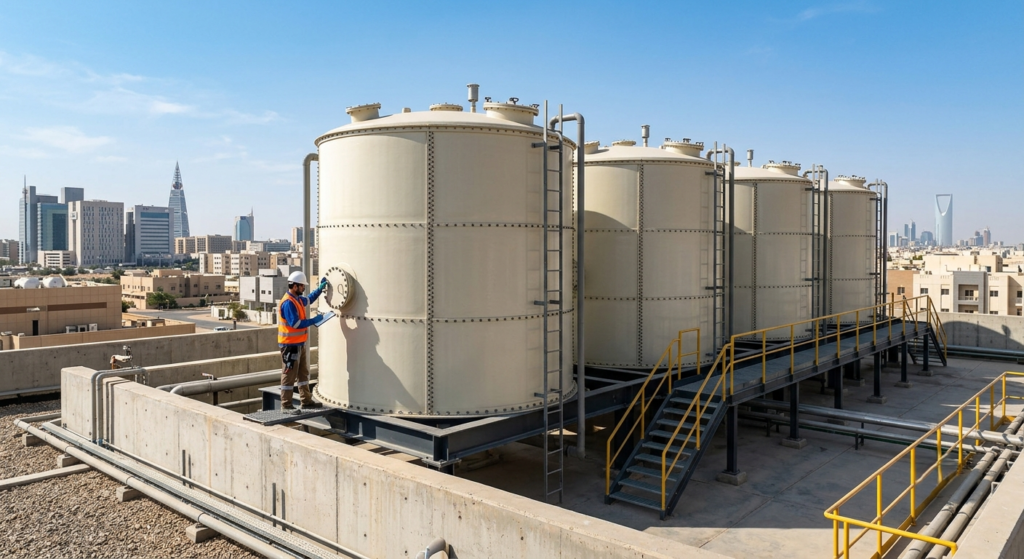
If you’re searching for a reliable water storage solution in Saudi Arabia’s demanding climate, you’ve likely come across the term GRP tank more than once. GRP (Glass Reinforced Plastic), also known as FRP (Fiber Reinforced Plastic), has become the go-to material for water storage across industrial plants, residential compounds, mosques, schools, and commercial facilities throughout the Kingdom. At Al Najof Fiberglass, we’ve spent over a decade manufacturing composite solutions from our facilities across Saudi Arabia, and in this guide, we’ll break down exactly why GRP tanks continue to replace traditional steel and concrete storage.
What Makes GRP Water Tanks Different?
Unlike steel tanks that rust or concrete tanks that crack over time, GRP panel tanks are built by bonding fiberglass sheets under high pressure into modular panels. These panels are then bolted together on-site to form a tank of nearly any size or shape, from small residential units to massive industrial reservoirs holding hundreds of cubic meters.
This modular design brings a few immediate advantages for buyers evaluating water storage options:
- Corrosion resistance — GRP does not rust, rot, or corrode, even when storing potable water, wastewater, or chemically treated water.
- Lightweight yet strong — Panels are significantly lighter than steel or concrete, reducing transport and installation costs, especially for rooftop or elevated installations.
- Hygienic storage — The smooth internal gel coat prevents algae buildup and bacterial growth, keeping stored water cleaner for longer.
- Thermal insulation — GRP naturally insulates against Saudi Arabia’s extreme heat, helping keep stored water cooler than metal alternatives.
- Long service life — With proper maintenance, GRP tanks routinely last 20+ years without major structural issues.
Common Applications Across Saudi Arabia
Fiberglass tanks aren’t a niche product anymore — they’re standard specification across many sectors:
Residential compounds and villas rely on rooftop or ground-level GRP tanks for daily domestic water supply, valued for their light weight and ease of installation on existing structures.
Industrial facilities use larger GRP panel tanks and FRP chemical tanks for process water, firefighting reserves, and corrosive chemical storage where metal tanks would degrade quickly.
Mosques, schools, and government buildings often specify GRP tanks because of low maintenance requirements and long-term cost savings compared to repainting or replacing steel tanks every few years.
Contractors and developers increasingly request GRP solutions in tender specifications because of faster installation timelines — modular panels can be assembled on-site in days rather than weeks.
Beyond Tanks: The Broader GRP/FRP Product Range
While water tanks are the most recognized product, composite manufacturing extends into a wide range of infrastructure and industrial products, including:
- GRP pipes and fittings engineered for high-pressure, corrosive fluid transfer
- GRP manhole covers that are lightweight, theft-proof, and non-corroding
- GRP ladders, platforms, and handrails for safe access in corrosive or wet environments
- FRP corrugated sheets for roofing and cladding with excellent light transmission
- FRP sunshades for solar control and energy efficiency
- Seamless GRP linings that protect concrete and steel structures from chemical attack
- Custom FRP signboards, doors, and plain sheets for commercial and industrial use
This breadth matters because it means a single supplier can handle an entire project’s composite material needs — from the water tank on the roof to the handrails on the stairwell — with consistent quality and warranty terms.
How to Choose the Right GRP Tank Supplier
Not all fiberglass tanks are manufactured to the same standard. When comparing suppliers, it’s worth asking about:
- Panel thickness and resin quality — thicker panels and higher-grade resin directly affect structural strength and longevity.
- Manufacturing experience — a supplier with over a decade of hands-on composite manufacturing will have refined quality control processes that newer entrants haven’t developed yet.
- On-site technical support — installation quality matters as much as the product itself; look for suppliers with technicians who can assess your site before manufacturing begins.
- Customization capability — every project has different space, capacity, and access constraints, so the ability to produce custom-sized panels and fittings is a major advantage.
- After-sales service — leak repairs, tank cleaning, and eventual capacity upgrades should be handled by the original manufacturer whenever possible.
Why Choose Al Najof Fiberglass
Al Najof Fiberglass has been manufacturing GRP and FRP solutions since 2013, with technicians operating across three locations in Saudi Arabia. Our product range spans fiberglass water tanks, GRP panel tanks, raw materials, gratings, pipes and fittings, manhole covers, ladders, platforms, handrails, and fully custom FRP fabrication for industrial, commercial, and residential projects.
Whether you’re a contractor specifying tanks for a new development, a facility manager replacing an aging steel tank, or a homeowner looking for a long-term water storage upgrade, our team can guide you through capacity planning, technical specifications, and pricing.
Get a Quote
Ready to upgrade your water storage or discuss a custom GRP/FRP fabrication project? Reach out to Al Najof Fiberglass with your project details, and our team will respond with technical guidance, pricing, and a solution tailored to your site.
Frequently Asked Questions
How long do GRP water tanks last? With routine inspection and cleaning, GRP panel tanks typically last 20 years or more, significantly outlasting untreated steel tanks in most environments.
Are GRP tanks safe for drinking water? Yes. GRP tanks used for potable water are manufactured with food-grade gel coats and resins that meet drinking water safety standards, and their smooth interior surface resists bacterial and algae growth.
Can GRP tanks be installed on rooftops? Yes. Their light weight compared to steel or concrete makes GRP panel tanks a common choice for rooftop installations, reducing the structural load on the building.
What sizes are available? Because GRP tanks are built from modular panels, they can be configured in a wide range of capacities, from small residential tanks to large industrial reservoirs holding hundreds of cubic meters.