
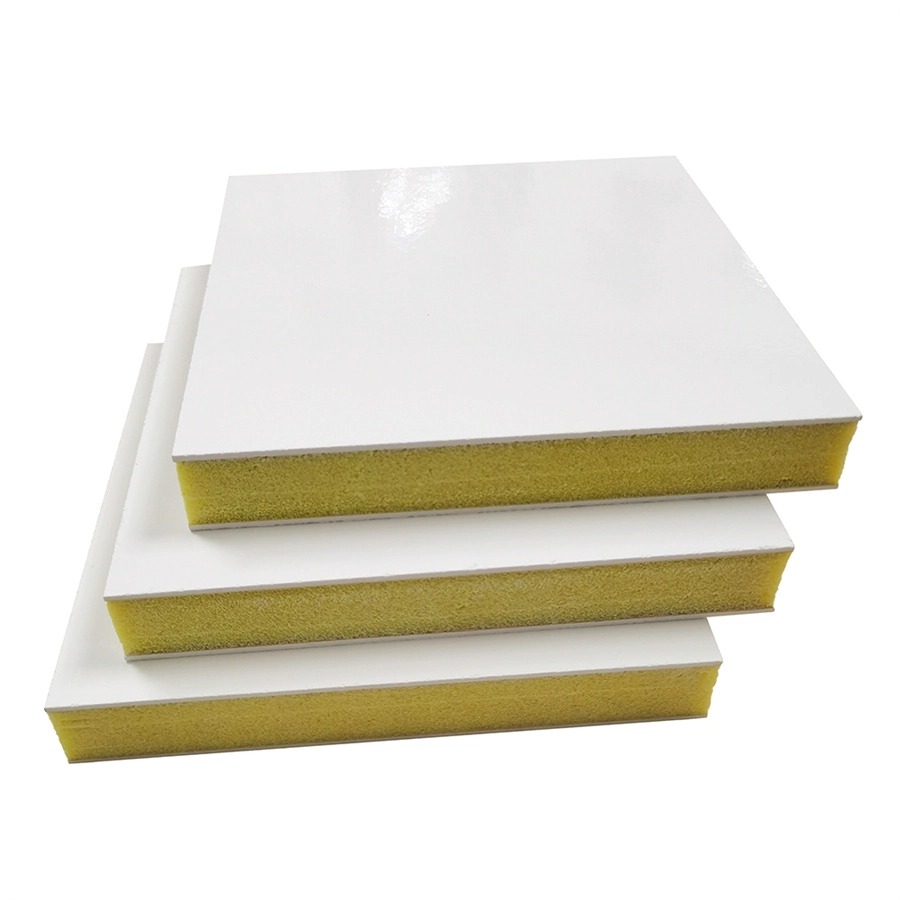
Al Najof Fiberglass manufactures FRP/GRP PU foam sandwich panels that combine two durable Glass Reinforced Plastic (GRP) skins with a rigid polyurethane (PU) foam core. The result is a lightweight, thermally efficient, corrosion-resistant panel suitable for walls, doors, enclosures, and other insulated building and industrial applications.
What Is an FRP/GRP Insulation Panel?
An FRP/GRP insulation panel is a factory-bonded sandwich panel. Its outer and inner GRP laminates provide strength, weather resistance, and a clean finished surface, while the closed-cell PU foam core delivers thermal insulation and structural rigidity.
GRP—also called fiberglass—is a composite of thermosetting resin and glass-fibre reinforcement. This makes it strong, lightweight, and highly resistant to corrosion, which is especially valuable in Saudi Arabia’s demanding industrial, coastal, and high-temperature environments.
Panel Construction
| Component | Typical specification |
| Outer skin | GRP laminate |
| Inner skin | GRP laminate |
| Core material | Rigid PU foam |
| Foam density | 40–45 kg/m³ |
| GRP skin thickness | 2–3 mm each side |
| Total panel thickness | 25, 30, 40, 50, 75, or 100 mm |
| Surface finish | Smooth, textured, or gelcoat |
| Colour | RAL colour as required |
| Bonding | Factory-bonded sandwich construction |
The recommended general-purpose specification for an insulated wall or door panel is a 50 mm panel with 2.0 mm GRP skins on both sides, a 46 mm PU foam core, and 40–45 kg/m³ closed-cell foam.
Thermal and Mechanical Performance
The PU foam core is designed to reduce heat transfer while keeping the panel light and rigid. Typical target properties include a thermal conductivity of 0.022–0.026 W/m·K, closed-cell content of at least 95%, and compressive strength of at least 0.10 MPa.
These characteristics make the panels suitable where insulation, dimensional stability, and resistance to moisture and corrosion are required. The exact performance depends on the panel design, foam formulation, adhesive system, and manufacturing quality.
Key Benefits
- Excellent thermal insulation: The PU foam core helps reduce heat gain and loss in buildings, cold rooms, equipment enclosures, and industrial structures.
- Lightweight construction: GRP skins and foam core create a panel that is easier to handle, transport, and install than many conventional insulated materials.
- Corrosion resistance: GRP faces resist rust and degradation in humid, coastal, chemical-exposed, and industrial environments.
- High strength-to-weight ratio: The sandwich construction provides rigidity without excessive weight.
- Design flexibility: Panels can be produced in multiple thicknesses, surface finishes, and RAL colours.
- Clean, durable finish: Gelcoat or smooth/textured GRP surfaces support attractive, easy-to-maintain installations.
Al Najof Fiberglass already supplies fiberglass panels for wall cladding, roofing systems, and industrial enclosures, making insulated FRP/GRP panels a natural extension of its composite-panel capability.
Typical Applications
FRP/GRP PU foam sandwich panels can be used in:
- Industrial wall cladding and partition systems
- Insulated doors and access panels
- Equipment and electrical enclosures
- Roofing and canopy systems
- Cold rooms and temperature-controlled spaces
- Portable cabins, kiosks, and modular structures
- Marine, offshore, and coastal structures
- Commercial and architectural façade applications
Al Najof serves infrastructure, industrial, municipal, commercial, and architectural sectors across the Middle East, with capabilities that include design, production, installation, and commissioning.
Manufacturing Process
A quality GRP-PU sandwich panel is produced through a controlled bonding process:
- Prepare the external GRP skin using UV-resistant gelcoat and glass-fibre reinforcement.
- Allow the laminate to cure.
- Prepare the rigid PU foam core to the required thickness.
- Apply a compatible adhesive to the bonding surfaces.
- Position the second GRP skin.
- Apply uniform pressure during bonding.
- Cure and trim the panel.
- Inspect thickness, bonding quality, surface finish, and dimensional tolerances.
For the recommended 50 mm panel, the construction consists of two 2.0 mm GRP skins bonded to a 46 mm PU foam core
Quality Assurance
Consistent panel performance depends on rigorous testing and inspection. Important quality checks include:
- GRP skin thickness measurement
- PU foam density testing
- Thermal conductivity testing
- Flatwise tensile or skin-to-core bond testing
- Compressive strength testing
- Water absorption testing
- Fire performance testing
- Panel bending and deflection testing where the panel is load-bearing
PU foam is combustible unless specially formulated. Therefore, fire ratings should never be claimed without an appropriate test report for the complete finished sandwich panel—not just the individual materials.
Why Choose Al Najof Fiberglass?
Al Najof Fiberglass is a Saudi Arabian manufacturer of GRP and FRP products, with experience across water tanks, pipes and fittings, gratings, cable trays, ladders, platforms, enclosures, kiosks, and custom-engineered components. The company provides end-to-end support, from design and manufacturing through installation and maintenance.
Based in Dammam, Al Najof understands the requirements of projects exposed to intense UV, heat, humidity, sandstorms, and corrosive industrial conditions. Its FRP/GRP insulation panels are engineered to provide dependable performance where durability, insulation, and low maintenance matter most.
Request a Technical Specification
For project-specific requirements, Al Najof Fiberglass can support panel thickness selection, skin specification, foam density, colour, surface finish, and installation requirements.
Contact the team at sales@alnajoffiberglass.com, call +966 13 833 3428,
or visit the company in Al Adamah, Dammam, Saudi Arabia.