
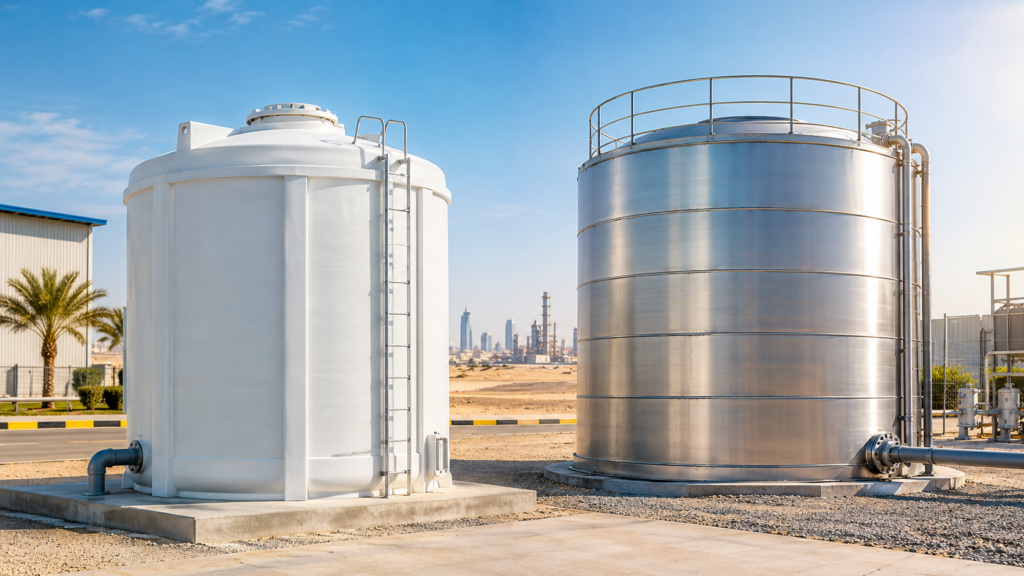
Choosing the right water storage tank is an important decision for homes, commercial buildings, factories and industrial facilities in Saudi Arabia. With extremely hot summers, strong sunlight and challenging environmental conditions, a water tank needs to offer reliable performance throughout the year.
Two popular options are GRP tanks and steel tanks. Both are used for water storage, but they differ in terms of heat resistance, corrosion protection, maintenance and long term value.
So which one is better for Saudi Arabia’s climate
In many applications, GRP tanks offer significant advantages because they are corrosion resistant, lightweight and suitable for demanding environmental conditions. However, the best choice depends on the installation location, water storage requirements and the quality of the tank.
Understanding the differences can help you make the right investment for your property or business.
Understanding GRP Water Tanks
GRP stands for Glass Reinforced Plastic. These tanks are manufactured using glass fibres combined with a resin system to create a strong and durable composite material.
GRP water tanks are widely used in residential buildings, commercial properties, hospitals, factories, agricultural facilities and other locations where dependable water storage is essential.
One of the main reasons businesses consider GRP tanks in Saudi Arabia is their ability to withstand challenging environmental conditions without the rusting problems associated with conventional steel.
GRP tanks are also available in different capacities and configurations, making them suitable for a wide range of water storage applications.
Understanding Steel Water Tanks
Steel tanks are commonly used for storing water in industrial facilities, commercial buildings and large infrastructure projects. Depending on the application, they may be manufactured from carbon steel or stainless steel.
Carbon steel tanks generally require protective coatings or suitable lining systems to help prevent corrosion. If these protective layers become damaged, moisture and environmental exposure can lead to rust.
Stainless steel tanks offer better corrosion resistance in many applications, but their performance still depends on the steel grade, water chemistry and surrounding environment.
Steel tanks can provide excellent structural strength when properly designed and maintained. However, the initial material cost, installation requirements and ongoing maintenance should all be considered before making a decision.
Why Saudi Arabias Climate Matters When Choosing a Water Tank
Saudi Arabia experiences very high summer temperatures, intense sunlight and dry conditions across much of the country. In coastal locations such as Dammam, Al Khobar and Jubail, humidity and airborne salt can also create additional corrosion challenges.
These conditions make material selection particularly important.
A water storage tank must do more than hold water. It should withstand local environmental conditions, protect the stored water and provide dependable service over many years.
For this reason, buyers should consider heat exposure, corrosion resistance, installation requirements and maintenance costs before choosing between GRP and steel tanks.
Heat Resistance and Performance in Hot Weather
Heat is one of the biggest concerns for water storage in Saudi Arabia.
GRP tanks can perform well in hot environments when manufactured with suitable materials and installed according to the manufacturers recommendations. Their composite construction also eliminates the rusting concerns associated with conventional carbon steel.
However, it is important to understand that GRP does not automatically keep water cool. Water temperature depends on several factors, including direct sunlight, tank colour, insulation, tank design and installation location.
Steel tanks can absorb considerable heat when exposed to direct sunlight. This can increase the temperature of the stored water, particularly in outdoor installations.
GRP tanks can also become hot under the same conditions, so proper installation and suitable insulation may be necessary when temperature control is important.
For buildings and industrial facilities in Saudi Arabia, selecting a tank with appropriate thermal protection can make a meaningful difference.
Corrosion Resistance in Saudi Arabia
Corrosion resistance is one of the most important differences between GRP and conventional steel tanks.
In coastal cities such as Dammam, Al Khobar and Jubail, humidity and salt exposure can accelerate corrosion in unprotected or inadequately protected steel structures.
Carbon steel tanks typically depend on coatings, linings and regular inspections to maintain their protective barriers. If the coating is damaged or deteriorates, corrosion can develop and eventually affect the tank.
GRP tanks do not rust because their structural material is not conventional steel. This makes them an attractive option for locations where corrosion is a major concern.
However, GRP is not completely immune to environmental damage. Prolonged ultraviolet exposure, unsuitable resin selection, chemical incompatibility and poor manufacturing quality can affect its service life.
Choosing a properly manufactured GRP tank designed for the intended application is therefore essential.
Maintenance Requirements
Maintenance is another factor worth considering when comparing GRP tanks and steel tanks.
Steel tanks may require regular inspection of their protective coatings, corrosion prevention systems, joints and internal linings. Depending on the tank design and operating conditions, repairs or recoating may be necessary.
GRP tanks generally require less corrosion related maintenance because they do not rust like conventional carbon steel.
Nevertheless, GRP tanks still need routine inspections. Owners should check for leaks, damaged panels, deteriorated seals, loose connections and signs of ultraviolet degradation.
Both types of tanks require appropriate cleaning and water quality monitoring when used for potable water storage.
For businesses looking to reduce routine maintenance work, GRP can offer a practical advantage, especially in environments where corrosion is a recurring problem.
Installation and Structural Considerations
The installation process can influence the total cost of a water storage system.
GRP tanks are generally lighter than comparable steel tanks, which can make transportation and handling easier. Modular GRP panel tanks can also be assembled on site, making them useful for buildings where access is restricted or where large storage capacity is required.
Steel tanks can offer excellent strength and may be suitable for applications involving specific structural or engineering requirements. However, their weight, foundation requirements, transportation and installation methods need to be considered during project planning.
The correct choice depends on the tank capacity, structural design, installation site and applicable engineering requirements.
For rooftop installations, engineers should verify the combined weight of the tank, stored water and supporting structure before installation. Water alone weighs approximately one thousand kilograms per cubic metre, so a full tank can place a substantial load on a building.
Long Term Value and Cost
When comparing GRP tanks and steel tanks, looking only at the initial purchase price can lead to the wrong decision.
A complete cost comparison should include the purchase price, transportation, installation, foundation requirements, protective coatings, inspections, repairs and expected service life.
A carbon steel tank may be an economical option for certain projects, particularly where suitable corrosion protection and maintenance arrangements are already available.
GRP tanks may provide better long term value in applications where corrosion resistance, reduced maintenance and easier handling are important priorities.
The final cost advantage depends on the project specifications, tank quality, operating environment and maintenance schedule.
For Saudi businesses, evaluating the total cost of ownership is a better approach than choosing a tank based on price alone.
Which Tank Is Better for Industrial and Commercial Applications
The right tank depends on how and where it will be used.
For residential buildings and commercial properties, GRP tanks can provide a practical water storage solution because they are lightweight, corrosion resistant and available in different capacities.
For industrial facilities, the decision should also consider the type of liquid being stored, operating temperature, chemical compatibility, structural loading and relevant safety requirements.
For coastal facilities in the Eastern Province, GRP tanks can be particularly attractive because they avoid the rusting problems associated with conventional carbon steel.
Steel tanks may still be the better choice for certain high temperature applications, specialised industrial processes or projects where specific structural and material requirements make steel more appropriate.
Neither material is automatically the best for every situation. Proper engineering, manufacturing quality and installation are essential for both.
How to Choose the Right GRP Tank in Saudi Arabia
Before purchasing a GRP water tank, consider a few important points.
First, determine the required storage capacity based on water consumption and the needs of the building or facility.
Second, confirm that the tank is manufactured using materials suitable for the intended water quality and operating conditions.
Third, consider whether the tank will be installed indoors, outdoors, underground or on a rooftop. Each location may require different structural and environmental protection measures.
Fourth, check whether additional insulation or ultraviolet protection is necessary for the local climate.
Finally, choose a reliable supplier that can provide clear product specifications, installation guidance and after sales support.
Taking these steps can help you select a tank that delivers dependable performance and value over the long term.
Why Choose Al Najof Fiberglass for GRP Tanks
When looking for GRP tanks in Saudi Arabia, working with an experienced fiberglass products supplier can help you identify a suitable solution for your project.
Al Najof Fiberglass serves customers looking for fiberglass and GRP products for different industrial and commercial applications.
Whether you need water storage for a commercial building, an industrial facility or another project, it is important to select a tank that meets your capacity requirements and suits the conditions at your installation site.
Before making a purchase, discuss the intended application, storage capacity, installation location and any special requirements with your supplier.
Choosing the right GRP tank from the beginning can help reduce maintenance concerns and support reliable water storage for years to come.
Final Verdict
For many water storage applications in Saudi Arabia, GRP tanks are an excellent alternative to conventional steel tanks. Their resistance to rust, relatively low weight and reduced need for corrosion related maintenance make them particularly appealing in hot and coastal environments.
Steel tanks remain valuable for applications that require specific structural properties or specialized material performance.
The best choice ultimately depends on the intended use, installation conditions, budget and engineering requirements.
If you are planning a water storage project in Dammam, Al Khobar, Jubail or elsewhere in Saudi Arabia, compare the full lifecycle costs and technical specifications before making your decision.
A well designed and properly installed tank can provide dependable performance regardless of which material you choose.